I took some time to consolidate my notes. Some were in the open program, shared with other researchers in our private network, others were on my tablet, and others I noted again as they emerged in memory.
I soon realized that this account must become simple. It must be small in order to be true. To do this, I must become more simple, innocent, perceptual, in order to write what is needed to be brought through me.
And at just that thought, a small package arrived at my door. Another dossier, from another researcher. Myth? meaning? I am required to take the time to step back, immerse myself in that document before returning to my task.
At the end of the day’s efforts I looked over my notes. It was clear to me that very little had been done about the Wunderkabinett. All I’d been doing was going over the experiences relating to the archivist, the stories of the past projects, and vague uncertain forebodings about the organization and my mission.
Was this a reality or was it a projected obstacle field? I’d been trained almost exclusively through projected obstacle fields (POFs) as there had to be lab simulations before I could be permitted actual tasks and missions. Here in the lab I was acting independently while a simulation – very realistic – would enable me to test my abilities. Was all that I’d just experienced a POF? If so, who was operating it, and why?
I laughed to myself that if it were not a POF, and was real, then I’d have exactly the same questions, but hopefully the answers would be a little less sinister. I needed to return to basics, so the next day I made a trip to HQ with an appointment at the watehouse.
There was a new curator in charge of the collection, and he was kind, personable. Young, with dark-rimmed glasses and black hair. They all wore uniforms now, but his was scientific, just a lab coat with the usual embroidered insignia patch. He was completely at ease and very helpful, taking me past the garden courtyard across the patio to a separate building he thought I’d be interested in seeing.
It was large and all one floor, spread out like a stripmall. I was aware that I had been there before – but how could that be?
He gave me the key and left me to find my way. Soon enough I had walked the entrie length of the warehouse, but there was very little for me to find here. Catalogued sealed boxes, stored furniture. On one wing of the building simulated rooms were set up with furniture, and objects of the time. These I enjoyed very much, but really saw little value in them, except I was haunted by a memory that I couldn’t quite grasp.
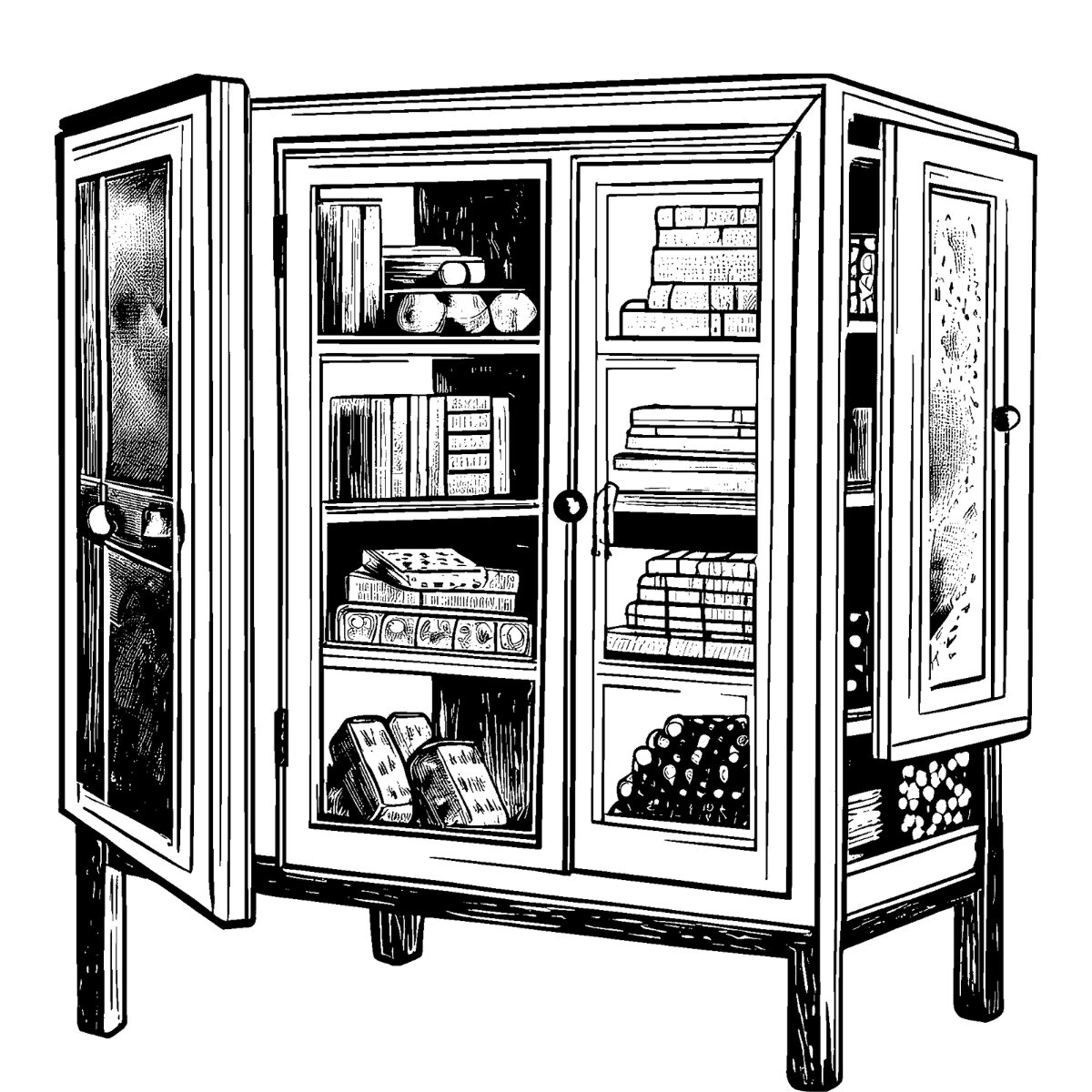
I was hunting, looking for significance or clues that could spur me on. It was all opaque and I really found no pleasure or interest there. The surface was too visible, too impermeable. Almost like perfect 3-D animation. Too perfect, too clean, what was it – bezels? Whatever it was, the look was unreal. Wait a minute – that may be my clue. These hologramesque room simulations held cabinets.
I went back, entered the first room again, paying attention to the light, the shadows, the textures, the slight breeze at the curtain, the scent of lavender, the glow of the gas radiant heater.
On the table was an abandoned game of some sort, with ivory chips and a game board made of painted canvas that could be easily rolled up and placed into its travel-tube that was lying beside it. A small pouch held chips and markers. It appeared the game could be played by up to eight, or even ten in a pinch, and the chips looked worn and well-used. Some paint had worn off the canvas, and the tube looked worn and well-used. There was a different game pattern painted on the other side of the canvas, and I supposed that the chips could be used in that game too.
That was my clue: the two sides of the canvas, the two games in one. “The secret second,” I thought to myself as I turned over the canvas to reveal a game that might have originally been snakes and ladders, but now it was something to do with animals and glaciers, arctic exploration to win the gold from the Northwest Passage. Furs and white carved whalebone whistles, small miniature face masks – smooth and cool. The more I looked at the gameboard, the more I marvelled.
But what is the use of marvelling at an unusual item? That is hardly the purpose and meaning of any wunderkabinett collection. More important is its other purpose, the role as part of the secret second, or as a key to discovery. For when I stepped out of the room simulation, I realized I’d been tricked by the display. Seeing the miniature face masks, all the objects that were inferred as part of that unusual game had begun to appear. They just came naturally into view as if they had always been there. But it was my attention that brought them forward. It was a resonant object that harmonized with my original focus. The more I looked, with a certain way of looking, the more these objects began to appear. That was actually the game in the centre of the room on the centre of a small round table.
I closed my eyes and allowed my mind to rest a beat before directing it away from the simulation room. I’d been nearly caught. But the clue was that this was a game, and all I needed to do was look behind the game. Still, I thought, so what? How do I get closer to the reality held in the wunderkabinetts?
I recalled that a drawer was just ever so slightly left open. It was only a quarter inch unclosed, so the drawer didn’t go in all the way. Not open but not flush with the frame either. I knew somehow, that the game was usually kept in that drawer, and that I could open the drawer and put the game away there.
I went back in. Everything kind of moved away from me, as much as any inanimate object could, just a small almost imperceptible concaving, a sort of withholding of presence. As if the objects had at one time been people or animals and victims of a cruel spell. Not really of course. How can that be?
I believed at that time that Project Wunderkabinett wasn’t going to be a release of beings held captive as objects, under a neutralizing spell for eternity. I had been taught that when one’s object became old or broken, one was able to hop into another object and animate it until it, too, became old.